Understanding Mortgage Points: A Homebuyer's Guide
Mortgages, Homebuying, Interest Rates
When Do Mortgage Points Make Sense for Homebuyers?
With 30‑year fixed mortgage rates hovering between about 7.10% and 7.24% as of November 2026 (according to Zillow, Bankrate, and Freddie Mac), many buyers are searching for ways to soften the blow of higher borrowing costs. One strategy you’ll hear about is buying mortgage points to “buy down” your rate—but this move only pays off in the right circumstances.
How Rising Mortgage Rates Affect Today’s Homebuyers
After years of ultra‑low rates, today’s 30‑year fixed purchase rates around 7.1%–7.2% mean the same home now comes with a noticeably higher monthly payment. According to recent data from Zillow, Bankrate, and Freddie Mac, buyers are paying hundreds of dollars more each month compared with a few years ago. That squeeze on affordability is why strategies like mortgage points are getting renewed attention: they can reduce your interest rate and your payment for the entire life of the loan—if used wisely.
What Are Mortgage Points and How Much Do They Cost?
Mortgage points—often called discount points—are an upfront fee you pay your lender at closing in exchange for a lower interest rate. It’s essentially prepaying some of the interest on your loan. Each point typically costs 1% of your total loan amount. So if you’re taking out a $400,000 mortgage, one point would cost $4,000 at closing. You can usually buy more than one point or even a fraction of a point, depending on how much you’re willing to spend upfront to reduce your rate.
You’ll see any points listed on your Loan Estimate, which you receive shortly after applying, and again on your Closing Disclosure before you sign your final paperwork. That transparency makes it easier to compare offers and understand exactly what you’re paying for.
How Mortgage Points Affect Your Interest Rate and Payment
In many cases, one point lowers your interest rate by about 0.25%. For example, if your quoted rate on a 30‑year fixed loan is 6%, paying one point might reduce it to 5.75% for the life of the loan. That may not sound dramatic, but over 30 years it can mean tens of thousands of dollars in interest savings. Research from sources like Bankrate and NerdWallet confirms this typical 0.25% reduction, though the exact benefit varies by lender, loan type, and overall rate environment.
Importantly, there are also origination points or fees—usually around 1% of the loan amount—that compensate the lender for processing and underwriting your loan. These do not reduce your interest rate directly. Some lenders may offer “no‑origination” loans but make up for it with a higher rate or other fees. Always confirm whether the points you’re seeing are discount points (which lower your rate) or origination points (which do not).
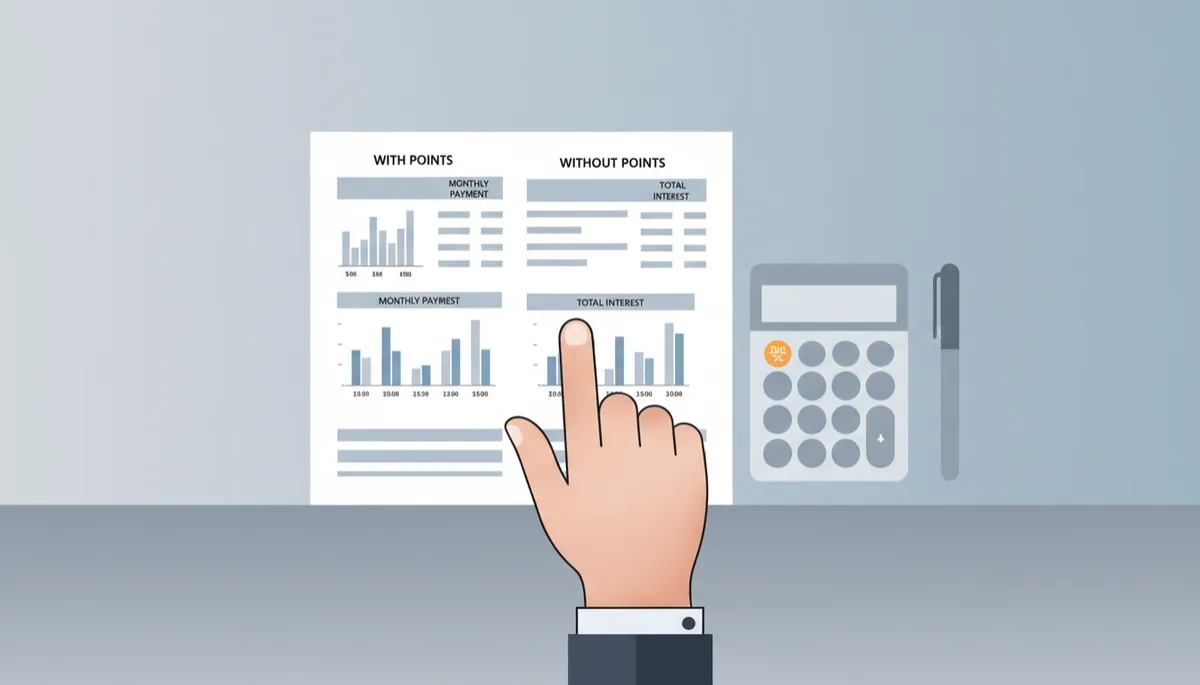
Side‑by‑side payment comparisons help reveal whether buying points truly pays off.
How to Calculate the Breakeven Point on Mortgage Points
The key to deciding whether mortgage points make sense is your breakeven point—the moment when your monthly savings from the lower rate add up to what you paid for the points. Industry resources like Investopedia and Bankrate describe a simple formula:
📌 Breakeven Formula: Cost of points ÷ Monthly savings = Months to breakeven.
Suppose you pay $4,000 for one point and it lowers your monthly payment by $65. Your breakeven would be: $4,000 ÷ $65 ≈ 62 months. That means you’d need to keep the loan for just over five years before you start coming out ahead. Many breakeven periods fall somewhere between three and seven years, depending on the size of the loan, the rate reduction, and current market rates.
When Mortgage Points Make Sense—and When They Don’t
Mortgage points tend to make the most sense when:
You plan to stay in the home longer than the breakeven period.
You have enough cash on hand for points after covering your down payment, closing costs, and an emergency fund.
You prefer the stability of a lower fixed payment rather than keeping more cash upfront.
On the other hand, points may not be a good fit if you expect to move, sell, or refinance before you reach your breakeven point. In that case, you’re likely to lose money because you won’t have held the loan long enough to recoup the upfront cost. The same concern applies if you’re stretching your budget just to afford the points; tying up too much cash can leave you financially vulnerable after closing.
Down Payment vs. Mortgage Points: Which Should You Prioritize?
A critical part of this decision is weighing down payment dollars against money spent on points. In many situations, putting extra cash toward a larger down payment can be more powerful than buying down the rate. A bigger down payment:
Reduces the size of your loan—and therefore the total interest you’ll pay.
Can help you qualify for a better interest rate even without points.
May allow you to avoid private mortgage insurance (PMI) if you reach at least 20% down, saving a significant monthly cost.
If you’re choosing between scraping together 20% down or paying for points, reaching that 20% threshold—and eliminating PMI—often delivers a clearer, more immediate benefit than a small rate reduction from points.
Understanding Loan‑to‑Value Ratio and Why It Matters
Your loan‑to‑value ratio (LTV) compares the size of your mortgage to the value or purchase price of the home. For example, if you buy a $500,000 home with a $100,000 down payment, your loan is $400,000 and your LTV is 80%. Lenders use LTV as a key measure of risk: the lower your LTV, the more favorable your loan terms are likely to be. A lower LTV can unlock:
Better interest rates without needing to buy points.
No PMI once you reach 80% LTV or lower on many loans.
More flexibility if home values dip, since you have more equity cushion.
Because of this, it often makes sense to use extra cash to lower your LTV before spending money on points—especially if that gets you below major thresholds like 90%, 85%, or 80% LTV, where pricing and PMI requirements can change significantly.
The Bottom Line: Don’t Assume Points Are Always the Best Move
Mortgage points can absolutely help you “beat” today’s higher rates—but only if the math and your plans line up. Before you commit cash to discount points, clarify how long you expect to keep the home, calculate your breakeven point, and compare that option against using the same money for a larger down payment to improve your loan‑to‑value ratio. When you run the numbers carefully and think about your long‑term plans, you’ll be in a stronger position to decide whether buying mortgage points truly makes sense for you.